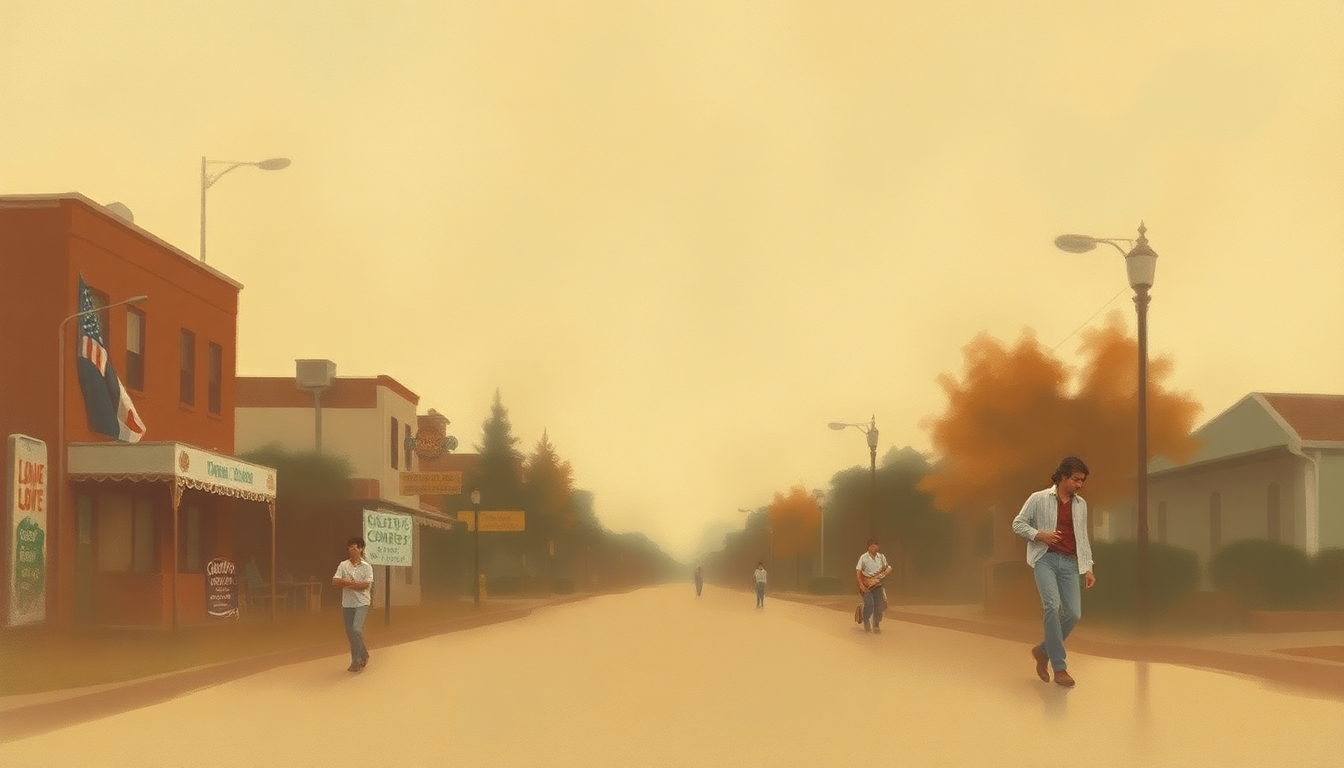
"Editorial abstract illustration evoking the emotional arc of a song titled "Love Street" by The Doors. Modest rise and fall. balanced composition. Mood: dreamy, nostalgic, romantic. Visual style: 1968 vintage painting aesthetic, warm aged tones. Painterly, grainy film texture, muted palette with strategic accent colors. The composition should read left-to-right like a timeline — calm on one side, intensifying toward the other. Strictly no faces, no text, no logos, no literal objects, no band imagery. Pure color-field abstraction with emotional weight. 16:9 editorial format."

Deep calm, gentler than 93% of our 19,209 measured songs — measures out best for focus.
95
BPM
Love Street by The Doors is 95 BPM — Andante (walking pace).
Half-time 48 BPM · Double-time 190 BPM · released 1968
Fan image for "Love Street"
An abstract illustration of what this song feels like. Each image is built from a prompt — the text description fed to the image generator. Listeners submit their own prompts, upvote the ones that fit best, and the top-voted prompt drives the next regeneration. After 100 image votes, we make a new picture.
Does this image fit the song?
0 agree · 0 not quite · 0/100 toward next regeneration
Prompts in the running for the next image
Upvote the prompts you think best capture the song. The top-voted prompt drives the next regeneration. Submit your own at the bottom.
No listener prompts yet. Be the first to submit one below.
How would you describe this song?
One or two sentences. Describe what the song feels like — a scene, a metaphor, a color, a place. Good descriptions are specific and sensory. Your submission becomes a candidate prompt that others can upvote.
Share:
Share on X
Explore from this song · jump to the numbers · FAQ
Find its sonic twinHidden gems like itDial itSongs like thisAll tools
Song DNA
Notes: Gentle psychedelic rock with smooth organ layers and mellow guitar riffs creates a warm, flowing atmosphere without harsh elements or abrupt shifts. Jim Morrison's romantic, poetic delivery remains soft and melodic throughout.
Misophonia Triggers
Recommended for: anxiety relief deep listening relaxation
A nostalgic love song inspired by Jim Morrison's Laurel Canyon street and life with Pamela Courson, featuring haunting keyboards and iconic guitar.
affiliate links
Hear it the way it was made
The right gear changes everything.
Moods: dreamy, nostalgic, romantic
Traditions: psychedelic rock
At a glance
"Love Street" by The Doors
95 BPM, dynamic range 4/10, smooth texture, soft vocals. Sits in the middle band — neither built for stillness nor pitched at workout intensity. Whether it works for a given moment depends more on mood and lyrical content than on the acoustic profile. The full sensory breakdown follows.
How this song sits on each sensory axis
A dynamic range of 4/10 is within the normal pop-mix band. There is variation between verse and chorus, but it's the kind of variation most listeners encounter routinely.
Sudden changes: none. Transitions are musically signaled — nothing will surprise you if you're only half-listening.
Texture: smooth.
Predictability is high — the song telegraphs what it will do next. A sensory-sensitive listener can usually guess where it's going without close attention.
Vocal style: soft vocals.
Where this sits in The Doors's catalog
We have 42 songs from The Doors in the library. Of those, 4 are rated Safe, 28 Moderate, and 10 Intense. This song's dynamic range of 4/10 sits below the artist average of 6.4, making it the #38 most dynamic track of theirs in our library.
1968 context
Released in 1968. We have 182 songs from that year in our library, averaging a dynamic range of 6.1/10. This track is quieter / less dynamic than the year average. Explore more from the 1960s.
Explore by mood and tradition
Traditions
psychedelic rock · 252Guides that may help
Jazz for Anxiety Relief: Which Subgenres Help and Which Overwhelm
Jazz for Anxiety Relief: Which Subgenres Help and Which Overwhelm — A guide for sensory-sensitive li…
How fast is "Love Street"?
95 BPM — Medium (midtempo / pop ballad)
For running
Too slow for most running; good for warm-up walks or cool-down.
For workouts
Warm-up, cool-down, yoga, stretching.
For daily life
Morning coffee, deep work, commute wind-down.
Browse more songs at 95 BPM.
When "Love Street" works, and when it doesn't
Use-case verdicts computed from the song's tempo, dynamics, and sensory profile.
✓
Focus / studying
Yes — low-variance volume, no surprises, steady tempo. The ideal study-music profile.
✗
Running / workout
No — 95 BPM is too slow for sustained cardio.
~
Sleep / winding down
Maybe — calm overall, but tempo is a bit high for deep sleep. Better for winding down than falling asleep.
✓
Driving / road trip
Yes — predictable enough for safe driving attention, interesting enough to stay engaged.
✓
Cooking / dinner background
Yes — sits in the background without demanding attention.
~
Emotional release / catharsis
Not really — it's pleasant but doesn't hit hard enough for cathartic listening.
Related reading
Editorial guides that cover this song's use cases, moods, or artist.

Jazz for Anxiety Relief: Which Subgenres Help and Which Overwhelm
Jazz for Anxiety Relief: Which Subgenres Help and Which Overwhelm — A guide for sensory-sensitive listeners on musiciwant.com

The counterintuitive reason some heavy metal is safer than a Taylor Swift album
Not all loud music is unsafe. Not all quiet music is safe. How doom metal, drone, and sludge rock score better for sensory sensitivity than …
Nick Cave's albums ranked by emotional darkness — which one is your nervous system ready for?
Nick Cave and the Bad Seeds made some of the most devastating music in rock history. But not all darkness is the same. This guide ranks his …
Why this rating
We rate this song Safe because its dynamic range stays within our low-variance band, there are no unsignaled changes, and the texture and vocal style are both in the low-fatigue range. Our methodology uses an AND rule for Safe — a song has to clear every dimension to earn the rating.
This song in the Music Studio
17/100 intensity
See how “Love Street” sits against your own sensitivities, or use it as a waypoint in a calmer set.
Listen on
Spotify and YouTube links go direct to the track when we have the ID; otherwise they search for it. Embed this sensory profile on your site →
Rating last reviewed: 2026-04-14. Reviewed by the Music I Want editorial team against the documented methodology.
Think this rating is wrong? Contact the editor — every message is read and ratings get revised.
By the numbers: how this song compares
Computed from this song’s place among the 19,209 songs we’ve measured.
Where it sits in 19,000 songs
This sits near the calm end of everything we've measured — gentler than 93% of the 19,209 songs in the library. Its intensity reading of 17/100 comes from a dynamic range of 4/10, smooth texture, no sudden shifts, and soft vocals. Relatively few songs occupy this exact corner of the spectrum.
What makes it unusual
What stands out most about this song is an unusually steady, even volume: more extreme on that axis than 97% of everything we've measured. At the far opposite end of the library sit the songs built on full chaos — sudden changes, huge quiet-to-loud swings, and relentless energy — the kind of track this one is the counterpoint to.
Feels almost identical to
Golden Hour — Kacey Musgraves · 99%Liberian Girl — Michael Jackson · 99%Oh Diane — Fleetwood Mac · 99%Lady and Man — Khruangbin · 99%
Closest matches by feel across all 19,209 measured songs — not by genre or artist, by how they actually move.
What it’s good for
Sleep9/10
Focus10/10
Workout0/10
Dinner7/10
Party / hype1/10
Scored from this song’s tempo, intensity, dynamics and texture — not crowd votes.
1968 in context
The 182 songs we’ve measured from 1968 average a dynamic range of 6.1/10. At 4/10, this track is gentler and steadier than its year.
Mixes smoothly with
Within a few BPM and close in feel — they flow without a jarring transition.
The fingerprint
Intensity17
Dynamics33
Tempo31
Surprise0
Density0
Predictability0
Vocal force25
Trigger load0
The 8-dimension measurement behind every rating on this page.
Frequently asked about "Love Street"
Quick answers pulled from the song's sensory analysis.
What is the BPM of "Love Street" by The Doors?
"Love Street" by The Doors has a tempo of 95 BPM (Andante (walking pace)). At half-time that is 48 BPM, and at double-time 190 BPM.
What is the sensory intensity of "Love Street" by The Doors?
"Love Street" by The Doors rates as Low-Intensity. Dynamic range 4/10, no sudden changes, smooth texture. Our Low-Intensity rating means no single dimension triggers the higher-intensity thresholds.
How loud is "Love Street" — what is its dynamic range?
"Love Street" has a dynamic range of 4/10. Within normal pop-mix variation. Movement between verse and chorus but nothing dramatic.
Does "Love Street" have sudden or surprising changes?
No. "Love Street" has no sudden unsignaled changes. Every transition is musically telegraphed.
What is "Love Street" best for?
In our library "Love Street" is recommended for: anxiety relief, deep listening, relaxation. These tags are assigned only where the song's sensory profile genuinely supports the use case.
When was "Love Street" released?
"Love Street" is from 1968, on the album "Waiting For The Sun". It appears in our 1960s catalog.
What is the emotional mood of "Love Street"?
We tag "Love Street" as dreamy, nostalgic, romantic. Moods are tonal descriptors based on how the song reads emotionally — separate from the sensory intensity axes.
What is the vocal style of "Love Street"?
The vocal style is soft vocals.
Is "Love Street" good for running?
Not really — at 95 BPM it's below most running cadences. Better for warm-up, cool-down, or walking. Recreational runners typically step at 140-175 BPM.
Is "Love Street" good for studying?
Yes — low dynamic range (4/10) and no sudden changes means the song stays in the background without pulling focus.
Can I use "Love Street" for sleep?
Not recommended for sleep. Dynamic range is too high — quiet moments will be ambushed by louder ones.
Should I listen to "Love Street"?
If you want gentle, low-arousal music, "Love Street" is a solid pick — Low-Intensity across every sensory dimension.
Songs with the same DNA
smooth texture, similar intensity — across any genre or era.
What this song means to people
No stories yet. Be the first.
Share what this song means to you
Keep exploring
Where to next?
You know how this one feels — now go find the next one.